CPM in marketing means cost per mille, or cost per thousand impressions: the average price you pay for your ad to show 1,000 times on Facebook, Instagram, YouTube or a site of the Google Display Network. It measures the price of attention, before any click.
You use it to compare what your campaigns cost to show, and to understand why a cost per sale goes up. It matters most for Meta Ads advertisers: Meta bills a sales campaign per impression, so the CPM is your bill. On one online store I work with, 1,000 impressions cost from 0.54 EUR to 94.46 EUR from one campaign to the next, depending on what each campaign asked the algorithm to do. Here you get the formula, what moves the price, and how to read it.
What Is CPM Used For
CPM measures the price of exposure. It gives you three things:
- Compare the price of attention: between two audiences, two placements or two formats, it shows which one costs more to show, at the same volume.
- Steer an awareness campaign: when the goal is to be seen, the cost of 1,000 views becomes the number that matters. Google recommends its viewable CPM bidding for awareness campaigns.
- Diagnose a cost per result: a cost per sale that goes up comes either from a CPM that goes up, or from a click rate or conversion rate that goes down. The CPM tells you which one moved.
How CPM Is Calculated
The formula fits on one line:
CPM = cost ÷ impressions × 1,000
A campaign that spends 633.38 EUR for 1,164,896 impressions has a CPM of 0.54 EUR. Meta defines it in its Marketing API reference as the average cost for 1,000 impressions. At Google, an impression is counted each time your ad is shown on a search result page or another site on the Google Network. So an impression is one display, and the same person can count for several.
Think of a poster in a train station. Its price depends on the crowd that walks past, whether people stop or not. CPM brings that price down to 1,000 passers-by, and it gives a simple rule: compare a CPM only with a CPM from the same goal.
A second formula links CPM to two numbers you already watch:
CPM = CPC × CTR × 1,000
It explains the most surprising gaps: an ad that gets many clicks shows a high CPM, even with cheap clicks. The site's CPM calculator does this breakdown on your own numbers.
On Meta, You Pay For The Impression, Even To Sell
On Meta Ads, the billing event defines what you pay for. According to the Billing Events page of Meta for Developers, updated on June 28, 2026, campaigns optimized for conversions on your website, leads, reach, value or landing page views are billed on impressions only. A few optimizations give you a choice, like link clicks, which you can pay per click or per impression.
So on a Meta sales campaign, your bill counts displays, and the optimization goal decides who gets your ad: Meta states it in its bidding overview. In each auction, the system combines your bid strategy, your bid amount and the probability of getting your optimization goal to calculate an effective bid. Your Meta CPM is the price of the people you ask the algorithm to find.
What 1,000 Impressions Cost On One Store
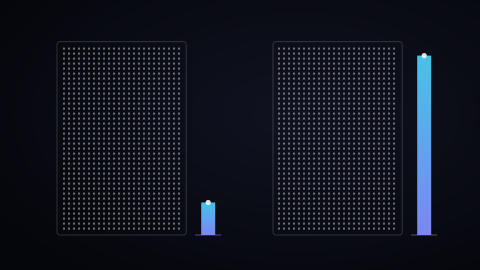
On the accounts of an online store I work with, the CPMs of the 90 days ending on October 15, 2026 range from 1 to 174:
- Meta, reach campaign: 0.54 EUR per 1,000 impressions, for a campaign that asks the algorithm to reach as many people as possible.
- Meta, sales campaign: 3.00 EUR, 5.5 times more, for a campaign optimized for purchases.
- Google Ads, Shopping: 7.77 EUR.
- Google Ads, Search: 94.46 EUR.
Search looks very expensive, and the second formula explains why. On this store, the Search CTR is 14.68%, against 1.15% on Shopping, with a click at 0.64 EUR on one side and 0.68 EUR on the other. So 1,000 Search impressions hold 147 clicks, and 1,000 Shopping impressions hold 11. On the Search Network, your bid is on the click and viewable CPM is not available: the Search CPM is a result you calculate. It is high because each display comes at the moment of a search, and that is good news!
So two CPMs compare only at the same goal, on your own account and from one period to the next. The four prices above buy four different things, as the guide Google Ads vs Facebook Ads also shows.
On Google Ads, CPM Becomes Viewable
Google uses CPM in two ways. As a metric, you can calculate it on any campaign. As a bid, it serves campaigns that buy visibility. The Google help says it at the top of its page on viewable CPM: Max. CPM is no longer available as a bid strategy. Viewable CPM (vCPM) replaces it, and you only pay for impressions measured as viewable:
- a display ad counts as viewable when 50% of it shows on screen for one second or more;
- a video ad, when it plays on screen for two seconds or more;
- you select vCPM on a "Display Network only" campaign, and it is not available for a "Search Network only" campaign.
In reports, the columns "Viewable impr.", "Avg. viewable CPM" and "Viewable rate" sit in the Viewability group. In its guide to choose a bid strategy, Google adds that manual vCPM is a poor fit when the campaign expects a direct response, like a purchase or a form. And its page on the move of Display campaigns to Demand Gen lists viewable impressions among the bid strategies Demand Gen does not support, with Maximize clicks as the alternative. The guide what is display advertising explains this change.
CPM, CPC Or CPA: Three Prices For Three Moments
The three metrics cut the same path into steps. CPM is the price of the display, CPC the price of the click, CPA the price of the result. They are linked: CPC equals CPM divided by 1,000 times CTR, and CPA equals CPC divided by the conversion rate.
The metric you steer with depends on the goal of the campaign:
- For an awareness campaign, CPM and frequency: the reach and frequency calculator shows how many times each person sees your ad.
- For a traffic campaign, CPC, which tells you what a visit costs.
- For a sales or lead campaign, CPA, and CPM helps you understand why it moves.
Common Mistakes With CPM
- Comparing different goals: on the same store, 0.54 EUR on reach and 3.00 EUR on sales buy two different audiences. The first aims at as many people as possible, the second at people likely to buy.
- Judging a sales campaign by its CPM: on Meta, it is billed per impression, and you judge it by its cost per purchase. Always read a falling CPM next to the CPA.
- Forgetting frequency: Meta defines frequency as the average number of times each person saw your ad. On the store's account, it is 1.78 over 90 days. A low CPM with a rising frequency shows the same people again and again.
- Putting Search against Meta: 94.46 EUR against 0.54 EUR on the same store. The gap comes from CTR, and it shows that the two channels play two roles.
The Limits Of CPM
CPM counts displays. A counted impression can pass in front of someone who looks elsewhere: this is why Google built viewable CPM, which only counts ads that stayed on screen long enough.
CPM also stops at the door of the platform. To judge the effect of an awareness campaign on your sales, it hands over to a measure of the whole business, MER, explained in the article ROAS vs MER.
The Three Most Searched Questions About CPM
What is a good CPM for Meta Ads? The one that matches your goal. On the same store and over the same period, Meta charged 0.54 EUR per 1,000 impressions on reach and 3.00 EUR on sales. Your best benchmark is your own CPM, at the same goal, from one month to the next: it tells you if your audience gets more expensive to reach.
CPM or CPC: which one should you choose? On Meta, a campaign optimized for link clicks lets you pay per click or per impression. Sales, lead and reach campaigns are paid per impression. On Google, viewable CPM serves awareness campaigns on the Display Network, and the Search Network does not offer it.
Is YouTube CPM the same thing? For an advertiser, yes: it is the price of 1,000 impressions. For a creator, the YouTube Help separates two metrics: CPM, the cost per 1,000 ad impressions before YouTube's revenue share, and RPM, the total revenue per 1,000 views after that share. So RPM is lower than CPM.
Before you judge a CPM, open your ads manager and write the goal of each campaign next to its cost per 1,000 impressions. Two CPMs with the same goal compare, the others tell two different stories. For an outside view of these numbers, see the Facebook Ads and Google Ads services.