In a classic recommendation system, every ad you launch carries an ID that belongs to it alone. The model learns what that ID is worth by watching the people who see the ad, click and buy. Until someone has seen it, the model has nothing to attach it to. On October 19, 2026, six Meta engineers described on the Engineering at Meta blog how they replace that number with a description of the ad.
GenRecs Tokenization is the way Meta represents each ad, product or page: a short sequence of tokens drawn from a stable semantic vocabulary, shared by similar items, in place of an ID unique to each item. It feeds GenRecs, short for Generative Recommenders, models that reason about an ad's content and a person's preferences at the same time, using the architecture of LLMs. Paired with GEM and the Adaptive Ranking Model, two other Meta models, it delivered a +0.35% lift in conversions across surfaces, according to Meta internal data measured in February 2026.
For you as an advertiser, it mostly changes what happens to a brand-new ad. Here is the mechanism, what Meta announces, its limits, and what I take from it for your creatives.
From Ephemeral IDs To A Stable Vocabulary
An ID is a label stuck on a closed box. It says nothing about what is inside, and it disappears with the ad: Meta itself calls them "ephemeral" IDs. Everything the model knows about an ad, it learned by serving it.
Tokenization opens the box. Pre-trained multimodal models read each ad, product and page, text and images included, and encode them into a representation that carries general knowledge of the world. The tokenizer combines that with what Meta has learned from how people engage with those items, then compresses the whole into a short sequence of tokens. Meta sums it up with an image: similar items share tokens, much as related words share roots. Shoe, shoelace and shoemaker don't need a definition each for you to guess they share a subject.
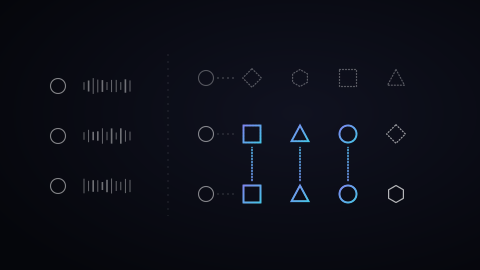
Going from an ad to its tokens takes three steps:
- Encode: each item is placed in a space where two close items have a close meaning.
- Decompose: that representation is split into independent subspaces.
- Quantize: each subspace is mapped to an entry in a codebook, a fixed list of codes. Those codes are the tokens.
For many ads, Meta chains these codes as prefixes: the first tokens place the item in a broad family, the next ones narrow it down. Two running shoes share the start of their sequence, a shoe and a sunscreen much less so. The vocabulary forms a hierarchy, from the broadest to the most precise, and it stays the same from one campaign to the next.
Your New Ad Inherits What It Shows
Meta's example speaks to any ecommerce advertiser. A sportswear brand launches next season's trail shoe. With an ID, the new ad got a fresh representation with no signal at all. With tokens, the new product and its ads build on what the model learned from last season's shoe, even before anyone sees the new ad.
Meta lists the cases where this inheritance matters most:
- New entities: newly created ads, niche products, pages with limited engagement.
- The long tail: ads that collect few impressions, which the model can now relate to others through shared content. Meta writes that this is where semantic tokens contribute most.
- Cross-campaign transfer: a stable vocabulary carries what was learned in one campaign over to the next ones.
A second-order effect follows. Predicting tail ads better improves the data the model trains on, and that data in turn improves predictions for all ads. Meta calls it a flywheel, a feedback loop that gains speed with every turn.
A second figure comes from the third-quarter earnings call on October 21, 2026. Susan Li, Meta's CFO, said that Meta Generative Recommender, launched in generative retrieval on Facebook Feed, drove a nearly 2% increase in conversions across targeted segments (call transcript). That figure covers the GenRecs approach to selecting candidate ads, and tokenization is one building block of it.
Both percentages are Meta's figures: averages across all advertisers, measured on systems that run together. Your Ads Manager doesn't isolate them anywhere, and they say nothing about your account in particular.
What It Changes For Your Creatives
If an ad is described by what it shows, its text and images become its first signal, before its first impression. If you follow Meta, the direction is familiar. My Meta audit checklist already says it, in the trap of its creatives section: "since Andromeda, targeting relies on creatives first". Andromeda is Meta's retrieval system, the one that preselects candidate ads. Tokenization points the same way, one level deeper: the content of your creative becomes the very material of its representation.
Two practical consequences follow. Meta details none of these cases: this is my reading of the mechanism, and I give it as such.
I think a variation that only changes the background color teaches the model very little. It shows the same object, the same message and the same promise as the original: its tokens are likely to look like the original's, and it sits right next to it. A new angle shows something else, another use, another person, another objection answered. That is what opens a new path for the system.
I don't recommend reviving a fatigued creative by duplicating it. The copy gets a new ID, and it shows exactly the same thing as the original. In a system that reads content, it brings the model no new information. My checklist asks for fatigued creatives to be "replaced, not just relaunched": tokenization gives one more reason to stick to it.
The Limits, And Where The Idea Comes From
Meta describes no setting to turn on. Tokenization runs inside its models, for every advertiser, and serves both retrieval, which picks candidate ads, and ranking, which orders them. It covers every item type in the system: ads, products, pages and pixels. According to the article, its coverage is still being extended to all items, so your whole catalog may not be covered yet.
The idea comes from research, and its lineage runs through three papers:
- 2023, TIGER: researchers from Google DeepMind and Google propose generating the semantic ID of the next item directly, and show the method recommends items with no history better (arXiv 2305.05065).
- 2023, YouTube: a Google DeepMind and Google team replaces video IDs with semantic IDs in a YouTube ranking model, with better generalization on new videos and the long tail (arXiv 2306.08121).
- 2025, Meta: AI at Meta brings prefix-based semantic IDs into its production ads ranking (arXiv 2504.02137). Kaushik Rangadurai co-authored that paper and the October 2026 article.
What is new in 2026 is the scale: one vocabulary shared by every item type, in production, for retrieval as well as ranking. Meta says it is exploring the next step: a single token space for the text, image, audio and video of ads, which would represent in one go what a person is interested in and what an advertiser has to offer.
What You Can Do From Your Next Campaign
I recommend starting with what your creatives show, before touching targeting:
- Describe each creative in one sentence: what it shows, to whom, with what promise. Two creatives that give the same sentence are two variations of the same angle.
- Vary the angles: I prefer two truly different angles over five colors of the same visual. The Meta creative testing calculator tells you how many creatives your testing budget can seriously carry.
- Show clearly what a new product is: its image and text are what the model reads first. A product that is hard to identify in the visual connects poorly to what the model already knows.
- Replace a fatigued creative with a new angle: the ad fatigue checker spots the day it starts to wear out.
- Judge on your own account: track the cost per result of your new ads over their first days, launch after launch. Your own history remains the only benchmark that speaks about your account.
A new ad now starts from what it looks like. My recommendation is to treat each creative as the description of your offer that the model reads before any impression. I suggest you run your active creatives through the one-sentence test before your next launch: the ones that give the same sentence are better off making room for a new angle. For an outside view on your account, discover the Facebook Ads management service.