ChatGPT Ads is OpenAI's ad platform. Your ads show up below ChatGPT's answers when the topic of the conversation matches what you offer, and you buy them in OpenAI's Ads Manager or through its API.
That is the definition, in two lines. What really changes for an advertiser fits in one: you buy no keywords. I built my first campaign on 10 September 2026, kept paused, and that single point is where most of the work went.
An ad below the answer, never in its place
Ads can appear at the end of an answer, when there is a relevant match with the conversation. OpenAI wants them clearly labeled as sponsored and visually separated from the answer, and states that they run on systems separate from the model: an advertiser has no way to shape, rank or alter what ChatGPT answers.
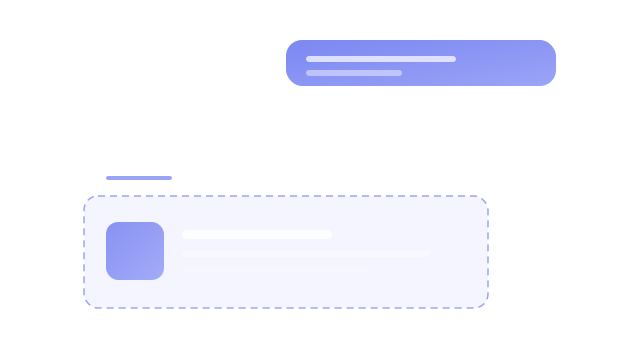
Think of the ad page facing an article in a magazine. The advertiser does not pick the reader, they pick the topic of the article, and their page sits next to the text without ever blending into it. In ChatGPT, the article is the conversation.
No keywords to buy: you describe situations
On Google, you buy a search. On Meta, you buy an audience. Here, one single field in the whole API carries intent: context hints, set on the ad group. I checked every schema in the official specification: the campaign, the ad and the account have no other semantic targeting field.
OpenAI's help center describes them as hints about the conversations, topics or keywords where your offer may be relevant. They guide the matching, but they are not exact-match keywords, and they do not guarantee delivery in any specific conversation.
So the question to ask becomes: what is the conversation about at the moment your offer becomes useful?
- "preparing a first meeting with an accountant" rather than "cheap accountant";
- "planning shifts for a team of ten" rather than "scheduling software".
My stance: I fill this field with situations, never with keywords copied from a Search account.
Who sees these ads
Ads reach users on the Free and Go plans. Plus, Pro, Business, Enterprise and Edu accounts do not get them. OpenAI does not show them to accounts identified as belonging to users under 18, and they cannot appear near sensitive or regulated topics, including personal health, mental health and politics.
On privacy, OpenAI states that it does not share conversations with advertisers and never sells them data. You receive aggregated results with no identifying information: total views, total clicks.
In Europe, one limit weighs on targeting: in the European Economic Area and Switzerland, personalized ads are not available at launch, and custom audiences are not supported on a campaign aimed at those countries. You are left with the country and the context hints, which makes the work on that field even more central there.
Who can advertise, and where
On 18 August 2026, OpenAI announced an expansion to 31 European countries, including France and Spain, and Ads Manager has been open there as self-serve since 31 August. In the United States, the test had started on 9 February 2026. The advertiser account is created in the company's name, which then invites the people who work on it, each with a role: your provider works on your account, never the other way round.
Industries remain framed. During the test period, OpenAI's ad policies mostly limit ads to consumer categories:
- lifestyle and household goods;
- local services;
- travel and experiences;
- digital products and education.
Outside the United States, financial services and health services are generally prohibited, and political ads are excluded. For a French or Spanish advertiser, that is the first thing to check.
What you buy: three modes, one relevance auction
Three buying modes are available:
- CPM, for reach: you pay per 1,000 impressions;
- CPC, for clicks: you pay per valid click;
- oCPC, in open beta: the platform optimizes for conversions but still bills per valid click.
The third one requires an event setting on the account, and a brand-new account has none, even when the pixel is already installed. To allocate the space, OpenAI uses a relevance-weighted, second-price auction. The consequence: a higher bid does not rescue an off-topic message, and the work you put into the message has a direct effect on what you pay.
Billing happens after delivery. The floor to know is the minimum daily budget: 15 EUR per campaign on a euro account, 25 USD in the United States.
The shortest format of the three platforms
A ChatGPT ad fits in 50 characters for the title and 100 for the body, 150 in total. For comparison:
- ChatGPT Ads: 50 for the title, 100 for the body;
- Google Ads, as a responsive search ad: 30 per headline, 90 per description;
- Meta: primary text has no cap that short, and across ten ads I manage for an e-commerce brand it runs between 299 and 382 characters.
Two creative types exist: the chat card, which combines an image, a title, a body and a link, and the product ad template, fed by a product feed.
Here, the title is the long field, almost twice Google's. The hook and the topic live in the title, and the body carries the proof and the call to action. A 350-character Meta ad gets rewritten from scratch.
What the specification does not say
Two server behaviors change how you start, and the API specification does not mention them. I ran into both while creating the campaign:
- The specification accepts 1 EUR a day, the server refuses anything under 15 EUR. The help center gives the right figure. When the specification and the server disagree, the server has the final word, and your test plan is built on its number.
- Automated bidding requires a daily budget. A campaign on a lifetime budget cannot hold an ad group that maximizes clicks. Testing with automated bidding therefore commits at least 15 EUR a day per campaign.
Measure before you spend
For a conversion to come back, it has to carry the click identifier. The platform adds it to your landing page address itself, the pixel keeps it for 30 days, then sends it back with the conversion. Without it, the platform receives a sale it cannot attach to any ad.
Four pieces need to be in place: the parameter in the destination address, the pixel on the site, the event declared on the platform side, and the trigger that sends it at the right moment, most often from Google Tag Manager. One is missing, nothing comes back, and no error tells you.
One point to settle in Europe before anything else: by default, the pixel treats consent as granted unless you tell it otherwise. It therefore gets wired to your consent banner, like your Google tags. OpenAI also states that its Conversions API, sent server-side, is a more reliable source than the pixel alone. It is the part I handle first, before the first ad.
When to start
ChatGPT Ads is worth testing when three conditions are met:
- your measurement already links a click to a sale or a lead;
- your industry is one OpenAI accepts outside the United States;
- you accept a learning budget, without comparing it right away to Google or Meta: the platform is too new for a performance average to mean anything.
A two-minute check before launch: your landing page has to let OpenAI's crawlers through, OAI-AdsBot and OAI-SearchBot. The review looks at the title, the copy, the image and the page itself, and usually takes a few minutes.
If one condition is missing, keep your budget on what already performs, and get the measurement ready in the meantime. That is exactly the order I follow in a ChatGPT Ads engagement: measurement first, then the first situations to test.